
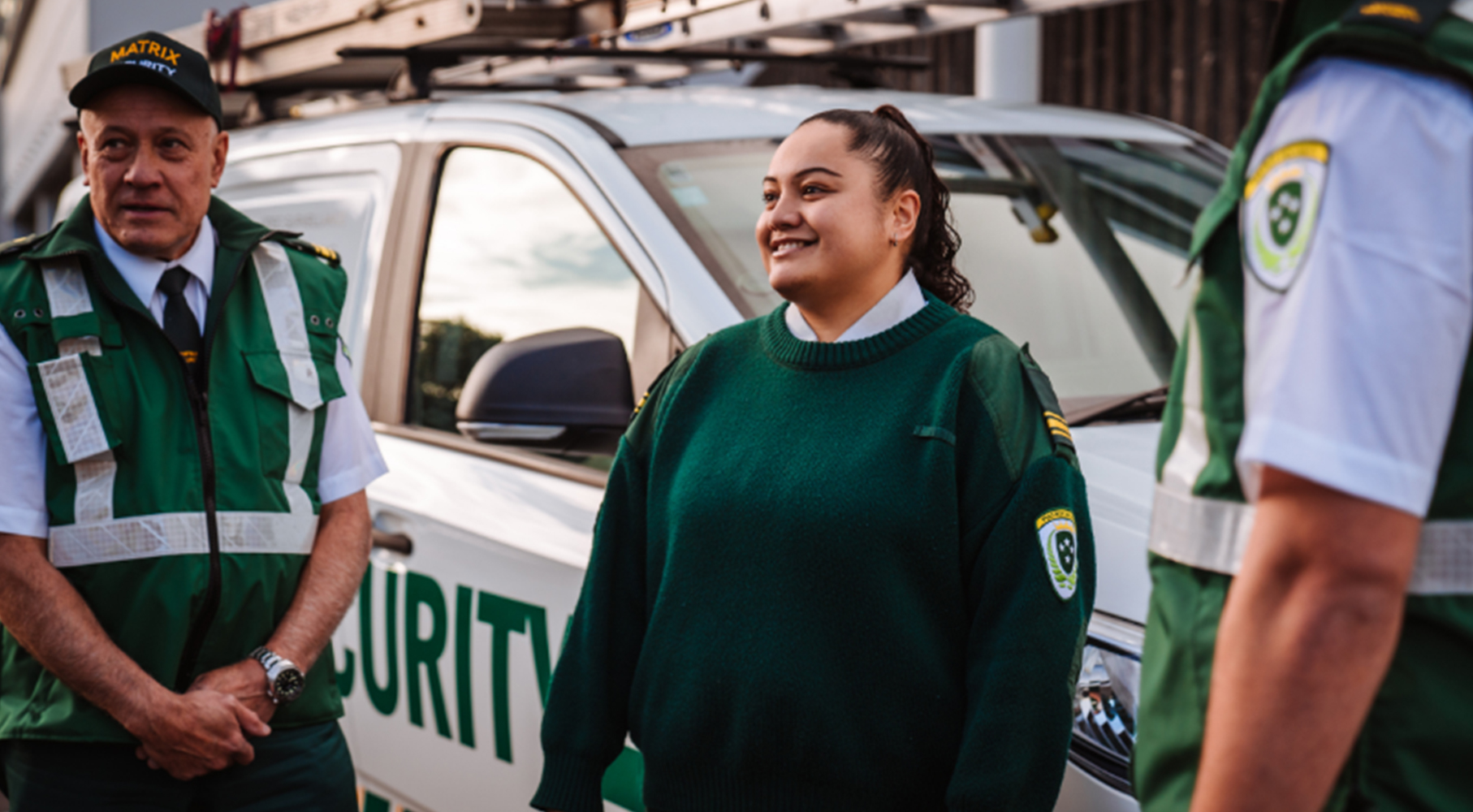
Matrix Security has provided commercial security to Auckland businesses for 30-plus years, with experience across static guards, mobile patrols and combined coverage. Deciding between static security guards and mobile patrols is a practical decision that depends on the site, its hours of operation, its risk profile and its budget, and there is no single answer that applies to every business. This article sets out a decision framework for both options.
Contents
- Static Security Guards, When They’re the Right Fit
- Mobile Patrols, When They’re the Right Fit
- Comparing Cost and Coverage
- When to Combine Guards and Patrols
- Frequently Asked Questions
Static Security Guards, When They’re the Right Fit
Static security guards are the right fit for sites that require a constant, visible presence together with a dedicated point of contact who can manage access as well as monitor the premises. This option suits businesses where an on-site presence delivers more than observation, supporting staff and providing a consistent point of contact for customers and visitors. At Matrix Security, static guarding is engaged in blocks of a minimum of four hours.
Auckland businesses that typically choose static guards include:
- Retail premises where a visible security presence supports customers and staff during trading hours
- Corporate offices with reception or access control requirements
- Events with crowd management or entry screening needs
- Construction sites during active working hours, where a guard can manage site access as well as security
- Venues that require control over who enters and exits, not only a record that they did
- Manufacturing plants and distribution or logistics centres that operate around the clock, where shift changes call for strict access control to protect employee safety, and where a guard’s presence helps reduce the risk of internal theft and supports more complex health and safety compliance
Access control and ID verification protect premises as well as the privacy and intellectual property held within them, and are common drivers behind this choice, since an on-site guard can manage entry in real time rather than after the fact. On more complex sites, this extends to managing the flow of people, confirming that visitors and contractors are expected on site and hold the right credentials, whether that is a scheduled appointment, a health and safety induction or another requirement, and escorting or directing them to where they need to go when required.
Presence on its own is not the whole picture, effective static guarding also depends on communication and training, as officers need to adapt on the spot and deal professionally with people at every level of a business. Static security guards in New Zealand must also be certified, holding a valid Certificate of Approval issued through the Ministry of Justice’s Private Security Personnel Licensing Authority, a qualification that is essential to properly protecting a site, which sets the licensing requirements for security officers.
For a deeper look at the benefits of on-site guards, see our guide to hiring professional security guards.
Mobile Patrols, When They’re the Right Fit
Mobile patrols are the right fit when a site does not require someone on-site around the clock but still needs regular, visible checks, particularly after hours or across more than one location. Patrol officers can attend at varying times throughout the day or night, adding an element of unpredictability to a site’s security. A mobile patrol security service covers ground that would be costly to staff permanently, making it a practical option for businesses managing risk across multiple locations rather than a single site.
Auckland businesses that typically choose mobile patrols include:
- Warehouses and industrial sites that require a bed down check overnight, confirming the premises have been properly locked and secured once staff have left
- Schools, healthcare facilities, offices, community facilities and other commercial sites that need a similar bed down check at the end of the day, confirming the premises are locked and secured before being left unattended
- Multi-site retail or hospitality groups that need consistent checks across several locations
- Vacant or under-construction premises that carry risk but do not justify a full-time guard
- Businesses wanting a visible deterrent through regular scheduled checks, without the cost of full-time staffing
- Sites where the risk is intermittent rather than constant, so a security patrol at varying times is more useful than a fixed post
Matrix Security’s mobile patrol vehicles are fitted with Teletrac Navman technology, including an in-vehicle camera and GPS reporting, which adds a layer of safety for officers and clients and allows incidents to be captured and reviewed. For sites better suited to a monitored check than a drive-by visit, virtual patrols using remote camera monitoring are also available alongside physical mobile patrols.
For more on how mobile patrols support crime prevention, see our article on the impact of mobile patrols.
Comparing Cost and Coverage
Static guards and mobile patrols differ mainly in how continuous the coverage is, and that difference shapes the cost. A static guard represents a higher ongoing cost because someone is rostered on-site, often across long shifts, in exchange for a constant presence. A mobile patrol spreads a security officer’s time across a scheduled route, which typically brings the cost per site down while still delivering regular, visible checks.
Cost and coverage are not the only factors worth weighing up. Mobile patrols offer a strong, visible deterrent through regular checks, while static guards provide a more personalised and engaged service, with greater interaction, responsiveness and familiarity with the site over time.
Pricing for both options depends on the site, the hours required and the risk profile, so costs vary from business to business, and a specific quote gives the most accurate figure.
| Factor | Static Security Guards | Mobile Patrols |
| Presence | Continuous, on-site | Scheduled checks across a route |
| Typical use case | High-value, high-risk or customer-facing sites needing constant presence | After-hours coverage, multi-site portfolios, vacant sites |
| Cost profile | Pricing varies based on site requirements, hours of coverage and risk profile. A tailored quote is recommended.
|
Generally, a more cost-effective option, with pricing based on patrol frequency, site location and risk profile. A tailored quote is recommended.
|
When to Combine Guards and Patrols
A static guard during trading hours, paired with mobile patrol checks once the site closes, is one of the most common combinations for Auckland businesses that need coverage across the full day rather than only part of it.
A retail complex might have a front-of-house guard managing customer access during trading hours, with patrol checks covering the site overnight. A multi-site business might staff its flagship location with a guard while smaller sites are covered by scheduled patrol visits, giving consistent oversight without a full-time guard at every address. Businesses running events or seasonal trading periods sometimes add patrol coverage around a core static guard presence for the duration of the higher-risk period.
A combined approach does not have to mean guards and patrols alone; virtual patrols can also be added as a technology-enabled layer for sites suited to remote monitoring. Coordinating guards, patrols and technology through a single provider give one team visibility of a site’s access requirements and incident history, rather than splitting that information across separate companies. It also means one point of contact for scheduling, reporting and any changes to coverage as a business’s needs shift. To talk through a combined coverage plan for your site, visit our mobile patrols and security guards service page.
Frequently Asked Questions
Should I hire security guards or use mobile patrols for my business?
It depends on the site. Where a constant, visible presence is required, particularly somewhere customer-facing or high-value, static guards are usually the better fit. Where a site closes at set hours, spans multiple locations, or needs periodic checks rather than a full-time post, mobile patrols typically make more sense. Many Auckland businesses use a combination of both.
What is the difference between static security guards and mobile patrols?
A static security guard is rostered to a single site for the duration of a shift, providing a continuous on-site presence. A mobile patrol covers a scheduled route across one or more sites, carrying out regular checks rather than remaining in one place. Both aim to reduce risk, but they do so in different ways.
When is a mobile patrol better than a security guard?
A mobile patrol tends to suit sites that are closed for periods of the day, such as warehouses overnight or vacant premises, or businesses managing several locations where a full-time guard at each site would not be practical, since regular checks can be delivered at a lower cost than continuous staffing.
Can I use both security guards and mobile patrols at the same site?
Yes. It is common for a site to have a static guard during trading or operating hours and mobile patrol checks once it closes, or for a flagship location to be staffed while satellite sites are patrolled. Combining the two is often the most practical way to match coverage to actual risk across the day.
What are virtual patrols, and how do they differ from mobile patrols?
Virtual patrols use remote camera monitoring to check a site, rather than a physical vehicle-based visit. They suit sites where cameras already cover the areas that matter, and can run alongside, or instead of, a physical mobile patrol. Matrix Security can advise whether a physical patrol, a virtual patrol, or a combination best suits a particular site.
How much does a security guard cost in New Zealand?
Pricing depends on the site, the hours required and the risk profile, so there is no single figure that applies across the board. Matrix Security can review a site and provide a tailored quote based on those specific requirements.
Choosing the Right Coverage for Your Business
The right choice comes down to how a site is used, not a fixed rule. Constant presence, scheduled checks, or a mix of the two, including technology-enabled options such as virtual patrols, can each be the better fit depending on a site’s hours, risk and layout.
Whichever option suits a site, Matrix Security’s officers are trained and hold the required industry approvals, with fast alarm attendance and incident response built into the service, and coverage that flexes from a single site to a multi-site portfolio. Guards and patrols also sit alongside Matrix Security’s wider security options, including security cameras and alarm systems, for businesses wanting a more complete setup. Get in touch with Matrix Security for a recommendation that best suits your business’ needs.